
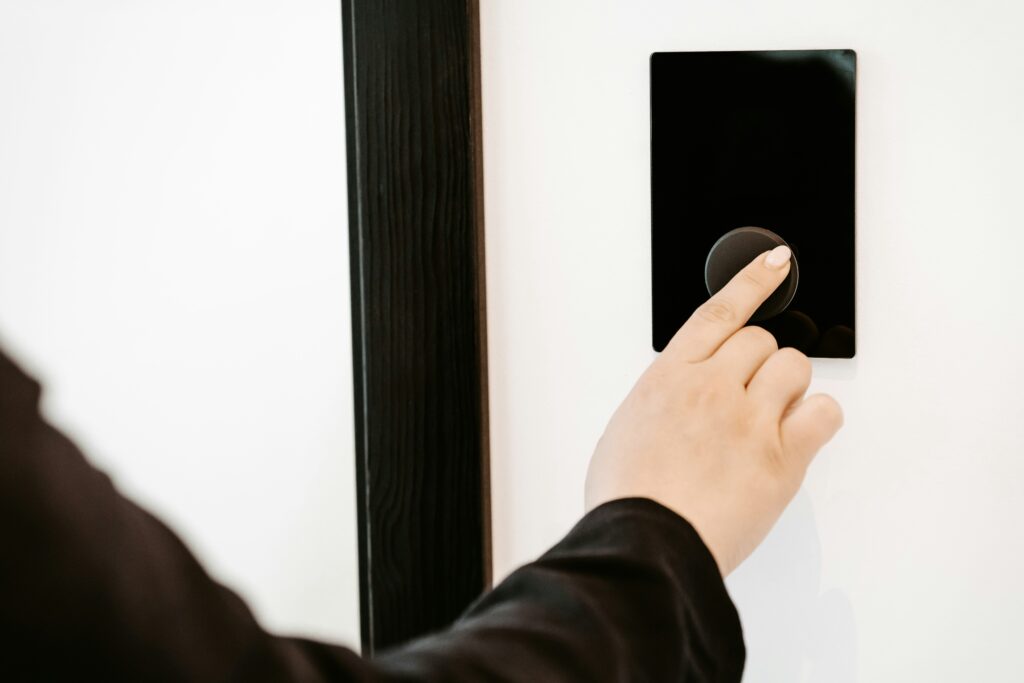
Physical security has changed significantly as businesses manage larger facilities, more sensitive information, and increasingly distributed workforces. Traditional access methods such as keys, swipe cards, and PINs remain useful, but they can also create security gaps when credentials are lost, shared, stolen, or improperly managed. Biometric access control offers another approach by verifying a person’s unique physical or behavioral characteristics before granting entry.
Rather than relying entirely on something an employee carries or remembers, biometric systems can identify individuals through fingerprints, facial features, iris patterns, or other distinctive characteristics. For commercial facilities, this can create a more controlled and traceable approach to managing physical access. As organizations look for stronger security without making everyday entry unnecessarily complicated, biometric technology is becoming an increasingly practical option.
Why Traditional Access Methods Leave Security Gaps
Keys, access cards, and passwords all depend on credentials that can potentially be transferred between people. An employee may lend a card to a colleague, lose a key, or have a password compromised. Even when organizations have strict policies, these risks can be difficult to eliminate completely.
Biometric authentication addresses part of this problem by connecting access authorization to the individual rather than simply to a physical credential. A fingerprint cannot be casually handed to another employee in the same way as an access card. Similarly, facial recognition systems can verify whether the person presenting themselves at an entry point corresponds to an authorized identity.
This does not mean biometrics are automatically more secure in every situation. System configuration, enrollment procedures, data protection, and physical security around biometric devices all matter. However, when properly implemented, biometric authentication can reduce several common weaknesses associated with conventional credentials.
How Biometrics Strengthen Commercial Facility Security
The primary advantage of biometric access control is stronger identity verification. A system can require a person to present a biometric characteristic before opening a restricted door, rather than accepting a card or PIN alone. This becomes particularly valuable in areas containing confidential documents, expensive equipment, research materials, or critical infrastructure.
For organizations evaluating solutions such as those discussed by the security integrator, biometric access control can also provide a more consistent method of enforcing access policies across different areas of a facility. Permissions can be assigned according to roles, departments, or security requirements, allowing organizations to restrict certain rooms while keeping general workplace areas accessible.
A well-designed system can also support detailed access records. Depending on the technology and configuration, administrators may be able to review when authorized individuals entered particular areas. These records can help with security investigations, compliance activities, and internal audits.
There are several biometric technologies businesses may consider:
- Fingerprint recognition: Commonly used because fingerprints are distinctive and relatively quick to authenticate.
- Facial recognition: Allows hands-free or low-contact authentication, although accuracy can depend on lighting, camera positioning, and system design.
- Iris recognition: Uses distinctive patterns in the eye and can provide highly specific identification for environments requiring stronger verification.
- Multimodal authentication: Combines biometrics with another factor, such as a card or PIN, when organizations require additional layers of protection.
The appropriate technology depends on the facility, threat model, workforce, privacy requirements, and operating environment.
Convenience Without Sacrificing Control
Security measures are most effective when employees can use them consistently. If access procedures are cumbersome, workers may look for shortcuts, creating new vulnerabilities. Biometrics can simplify entry by reducing dependence on cards, keys, or memorized codes.
For example, an employee who regularly enters a secured office may authenticate with a fingerprint or facial scan instead of searching for an access card. This can make routine movement through controlled areas more straightforward while maintaining centralized authorization.
Infassure highlights biometric access control as a way for commercial facilities to strengthen their physical security architecture. The broader value, however, comes from integrating authentication into a well-managed access strategy rather than treating biometrics as a standalone security measure.
Organizations should also consider accessibility and operational realities. Some employees may have difficulty using particular biometric technologies, while environmental factors can affect certain sensors. Providing suitable alternatives and establishing procedures for authentication failures can prevent security controls from becoming an operational obstacle.
Protecting Sensitive Areas and Reducing Unauthorized Entry
Not every part of a commercial building requires the same level of protection. Reception areas, meeting rooms, employee workspaces, server rooms, laboratories, and records storage may have very different security requirements.
Biometric access systems can support this layered approach by applying stronger authentication to areas where unauthorized entry could have serious consequences. A company might allow employees to enter general office spaces with a standard credential while requiring biometric verification for a server room or restricted research area.
This principle of least privilege is important in modern security management. Employees should generally receive only the access necessary for their responsibilities. When combined with role-based permissions, biometric systems can help organizations make physical access more closely reflect business needs.
Another advantage is the potential to make access management more responsive. When an employee changes departments or leaves an organization, administrators can modify or revoke their authorization centrally. This can reduce the dependence on recovering physical keys or access cards, although organizations should still maintain appropriate offboarding procedures.
Privacy and Data Protection Must Remain Priorities
Biometric security introduces an important responsibility: protecting biometric information. Unlike a password, a biometric characteristic cannot simply be changed if compromised. Consequently, organizations must carefully consider how biometric data is collected, stored, processed, and protected.
Businesses should understand the applicable privacy and data-protection requirements before deploying biometric systems. They should also establish clear policies covering employee consent where required, data retention, access to biometric records, and deletion procedures.
Technical safeguards are equally important. Strong encryption, secure device management, limited administrative access, software updates, and network segmentation can help reduce the risk of unauthorized access to biometric systems. Organizations should also evaluate whether a solution stores raw biometric images or uses protected mathematical representations, as these approaches can have different security and privacy implications.
Building Biometrics Into a Broader Security Strategy
Biometric access control works best as one component of a wider physical and cybersecurity program. Cameras, alarms, visitor management, security personnel, environmental controls, and digital identity systems can complement biometric authentication.
Before deployment, businesses should assess which locations actually require biometric verification and identify possible failure scenarios. They should consider what happens during network outages, device failures, power interruptions, or unsuccessful authentication attempts. Backup procedures are essential because a security system must remain useful during unexpected conditions.
Regular reviews are also important. Access permissions should be audited, devices maintained, authentication records monitored appropriately, and employees trained on relevant procedures. These practices help ensure that the technology continues to support the organization’s actual security requirements as its workforce and facilities change.
End Note
The shift toward biometric access control reflects a broader move toward identity-based physical security. By verifying people through distinctive characteristics, businesses can reduce dependence on easily transferred credentials while creating more controlled access to sensitive areas.
However, biometrics are not a substitute for sound security planning. Their effectiveness depends on appropriate technology selection, careful implementation, privacy safeguards, access policies, and ongoing administration. When these elements work together, biometric authentication can provide commercial facilities with a practical additional layer of protection—one designed around verifying who is actually requesting access rather than relying solely on what that person possesses or remembers.
 Drevian Quenvale writes the kind of ai algorithms and machine learning content that people actually send to each other. Not because it's flashy or controversial, but because it's the sort of thing where you read it and immediately think of three people who need to see it. Drevian has a talent for identifying the questions that a lot of people have but haven't quite figured out how to articulate yet — and then answering them properly.
They covers a lot of ground: AI Algorithms and Machine Learning, Tech Innovation Alerts, Expert Tutorials, and plenty of adjacent territory that doesn't always get treated with the same seriousness. The consistency across all of it is a certain kind of respect for the reader. Drevian doesn't assume people are stupid, and they doesn't assume they know everything either. They writes for someone who is genuinely trying to figure something out — because that's usually who's actually reading. That assumption shapes everything from how they structures an explanation to how much background they includes before getting to the point.
Beyond the practical stuff, there's something in Drevian's writing that reflects a real investment in the subject — not performed enthusiasm, but the kind of sustained interest that produces insight over time. They has been paying attention to ai algorithms and machine learning long enough that they notices things a more casual observer would miss. That depth shows up in the work in ways that are hard to fake.
Drevian Quenvale writes the kind of ai algorithms and machine learning content that people actually send to each other. Not because it's flashy or controversial, but because it's the sort of thing where you read it and immediately think of three people who need to see it. Drevian has a talent for identifying the questions that a lot of people have but haven't quite figured out how to articulate yet — and then answering them properly.
They covers a lot of ground: AI Algorithms and Machine Learning, Tech Innovation Alerts, Expert Tutorials, and plenty of adjacent territory that doesn't always get treated with the same seriousness. The consistency across all of it is a certain kind of respect for the reader. Drevian doesn't assume people are stupid, and they doesn't assume they know everything either. They writes for someone who is genuinely trying to figure something out — because that's usually who's actually reading. That assumption shapes everything from how they structures an explanation to how much background they includes before getting to the point.
Beyond the practical stuff, there's something in Drevian's writing that reflects a real investment in the subject — not performed enthusiasm, but the kind of sustained interest that produces insight over time. They has been paying attention to ai algorithms and machine learning long enough that they notices things a more casual observer would miss. That depth shows up in the work in ways that are hard to fake.