Every device you own, from your phone to your smart fridge, needs a unique address to access the internet. It’s like how every house needs a mailing address. But there’s a snag.
The original addressing system, IPv4, is nearly exhausted. Imagine a traffic jam on the internet highway. That’s the problem we’re facing.
Enter IPv6, the next-generation protocol designed to clear this bottleneck and fuel internet growth. But what’s the real difference? And why should you care?
This article breaks it all down with a clear, analytical look at the ipv4 ipv6 comparison. Trust me, I’ve dug deep into network protocols and digital systems to cut through the jargon. You’ll get a full understanding of not just what the differences are, but why they matter for the future of technology.
IP Addresses: The Digital Street Address
Let’s get straight to it. Internet Protocol (IP) is basically a set of rules for sending and receiving data online. Think of an IP address as a digital street address. It makes sure your data packets reach the right destination.
Without it, the internet would be chaos.
Now, here’s where things get interesting: the ipv4 ipv6 comparison. IPv4 has been around forever (since 1983!), but we’re running out of those addresses. Enter IPv6.
It’s the new kid on the block, designed to handle the internet’s growth.
Why does this matter to you? Well, transitioning from IPv4 to IPv6 is one of the biggest upgrades in internet history. It’s happening slowly, but it’s key.
If you’re considering implementing vpn solutions small businesses, understanding IP versions can help you make informed decisions. So, next time you surf the web, remember what’s happening behind the scenes.
IPv4 vs. IPv6: The Technical Deep Dive
Let’s talk address space. IPv4 uses a 32-bit structure, meaning its addresses are like grains of sand on a beach: limited and finite. IPv6, however, steps it up with a 128-bit structure.
Imagine IPv4 as a single grain of sand, whereas IPv6 is the size of the entire sun. That’s a whole lot more room to play with. Want examples?
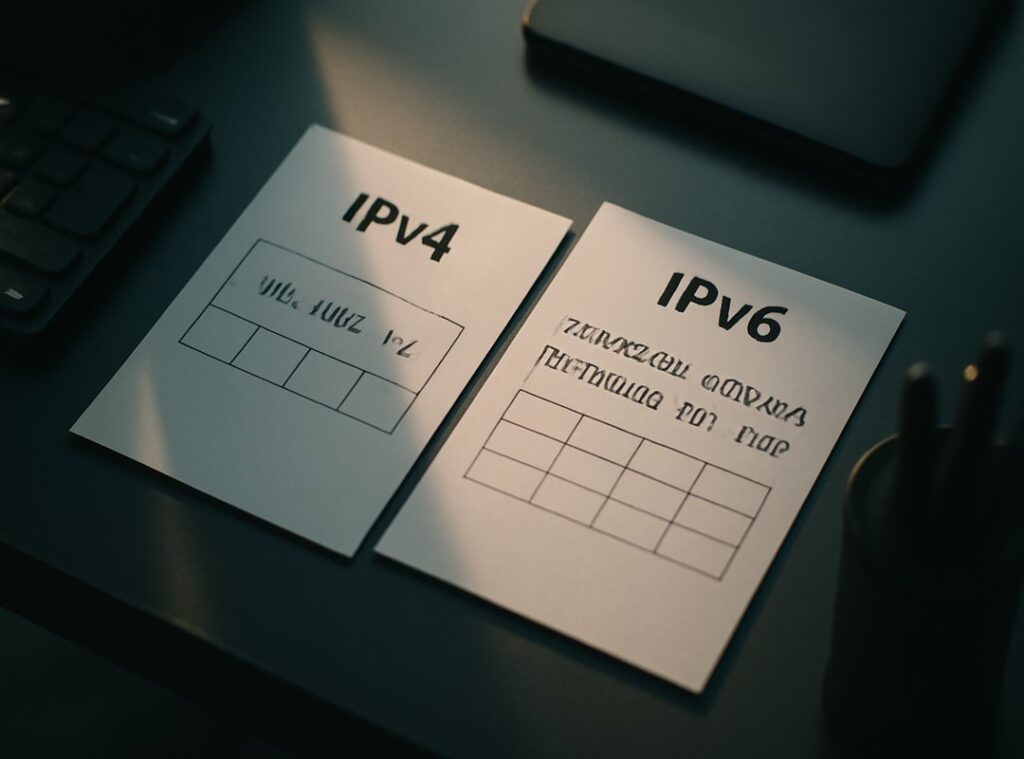
Sure thing. An IPv4 address looks like this: 203.0.113.1. Simple.
IPv6? It’s 2001:0db8:85a3::8a2e:0370:7334. Long, but it does the job.
Now, on to address configuration. IPv4 typically relies on DHCP servers to dole out addresses. It’s a bit like a traffic cop directing cars.
IPv6, though, lets devices assign themselves an address using Stateless Address Autoconfiguration (SLAAC). It’s like giving each car its own GPS. This self-sufficiency means less hassle for network management.
No more waiting for the DHCP guy to show up.
Security is where IPv6 really shines. While IPv4 uses IPSec as an optional add-on, IPv6 has it built-in. This means end-to-end security is part of the package, not an afterthought.
You’re not just bolting on extra armor; it’s integrated into the core of the protocol. That’s peace of mind without the extra effort.
Then there’s the packet header. IPv6 has a simplified, streamlined header. It drops the unnecessary baggage that clutters IPv4 headers.
This means routers can process information faster, making routing more fast. It’s like switching from a clunky old typewriter to a sleek laptop. Less overhead, more performance.
If you’re curious for more on this topic, check out the ipv4 ipv6 comparison. It’s a solid resource for diving deeper.
So, what’s the takeaway? IPv6 is the future. It offers more space, easier management, built-in security, and better performance.
If you’re still clinging to IPv4, it’s time to rethink. The tech world moves fast, and IPv6 is where it’s headed. Why not get ahead of the curve?
Beyond the Bits: Real-World Impact and Practical Benefits
IPv4 and IPv6. It’s not just about numbers or tech jargon. It’s about how these protocols change the game.

The ipv4 ipv6 comparison is more than technical specs; it’s about real-world impact.
For the Internet of Things (IoT), IPv6 is a game-changer. Why? Because of its near-limitless address space.
Every sensor, smart home device, and industrial monitor can have its own unique public IP address. IPv4 just can’t handle that. We’re talking billions of devices.
This capability isn’t just a luxury. It’s important for the IoT’s expansion. Think about it: every device connected, no middleman.
That’s solid.
Businesses and network admins, listen up. IPv6 offers simplified network management. No more wrestling with complex NAT (Network Address Translation).
Autoconfiguration is your friend here. It makes life easier and future-proofs your infrastructure. And let’s be honest, who doesn’t want a network that’s ready for what’s next?
NAT broke the end-to-end connectivity principle. IPv6 restores it. That’s a win for everyone.
Everyday users, you benefit too. IPv6 can improve your online experiences. More direct peer-to-peer connections mean better online gaming and smoother video calls.
And mobility? Mobile IPv6 is more fast than its IPv4 counterpart. Devices stay connected while moving between networks.
Seamlessly. No more dropped connections when you switch from Wi-Fi to mobile data. It’s fast and strong.
So, what’s the takeaway? IPv6 isn’t just a technical upgrade. It’s a necessity for the future.
Curious about how all this fits into the bigger picture? Check out understanding tcp ip network beginners. It ties all these elements together.
Understanding this shift is key. Not just for techies, but for anyone navigating our connected world.
IPv6 is here to stay. Embrace it.
The Great Migration: IPv4 to IPv6 Challenges
If IPv6 is such a leap forward, why hasn’t everyone jumped on board? That’s a question I hear all the time. The crux of the problem? Lack of backward compatibility. IPv4 and IPv6 don’t play nice together.
They require special transition mechanisms to even stare at each other, let alone communicate.
Common strategies like Dual Stack, Tunneling, and Translation (ever heard of NAT64?) attempt to bridge this gap. Dual Stack means running both protocols at the same time. Sounds simple, right?
But it’s not. It’s messy and resource-hungry. Tunneling encapsulates IPv6 packets within IPv4 packets.
Imagine wrapping a gift twice, unnecessarily complex. Translation? It’s like using a series of translators between languages.
Each has its flaws.
And then there’s inertia. Businesses and individuals alike face high costs and complexity in upgrading existing systems. It’s not just software but hardware too.
And you know what? IPv4 still works. For many, there’s no rush when the old system still does the job.
Yet, the reality of IPv4 address exhaustion is becoming impossible to ignore. We can’t squeeze more out of what’s not there. Slowly but surely, adoption is climbing.
Companies are starting to see the writing on the wall. In a classic case of “better late than never,” the transition to IPv6 is gaining momentum. The move might not be swift, but it’s undeniably happening.
Keep an eye out (it’s) a game of patience and persistence.
Embrace the Future of Internet Protocols
IPv4 has hit its ceiling. That’s the truth. We’re all feeling it.
The limitations are stifling growth and innovation. But the answer is clear: IPv6. It’s not just a theoretical upgrade.
It’s a necessity for a secure, flexible, and fast global network. The ipv4 ipv6 comparison isn’t just numbers on a page; it affects everything from IoT to your browser speed. Curious about where you stand?
Check your network’s IPv6 readiness. Start exploring these protocols now. Stay ahead.
Don’t let your network hold you back. Dive into IPv6. Your future online depends on it.
 There is a specific skill involved in explaining something clearly — one that is completely separate from actually knowing the subject. Editha Millerstane has both. They has spent years working with ai algorithms and machine learning in a hands-on capacity, and an equal amount of time figuring out how to translate that experience into writing that people with different backgrounds can actually absorb and use.
Editha tends to approach complex subjects — AI Algorithms and Machine Learning, Scribus Network Protocols, Tech Innovation Alerts being good examples — by starting with what the reader already knows, then building outward from there rather than dropping them in the deep end. It sounds like a small thing. In practice it makes a significant difference in whether someone finishes the article or abandons it halfway through. They is also good at knowing when to stop — a surprisingly underrated skill. Some writers bury useful information under so many caveats and qualifications that the point disappears. Editha knows where the point is and gets there without too many detours.
The practical effect of all this is that people who read Editha's work tend to come away actually capable of doing something with it. Not just vaguely informed — actually capable. For a writer working in ai algorithms and machine learning, that is probably the best possible outcome, and it's the standard Editha holds they's own work to.
There is a specific skill involved in explaining something clearly — one that is completely separate from actually knowing the subject. Editha Millerstane has both. They has spent years working with ai algorithms and machine learning in a hands-on capacity, and an equal amount of time figuring out how to translate that experience into writing that people with different backgrounds can actually absorb and use.
Editha tends to approach complex subjects — AI Algorithms and Machine Learning, Scribus Network Protocols, Tech Innovation Alerts being good examples — by starting with what the reader already knows, then building outward from there rather than dropping them in the deep end. It sounds like a small thing. In practice it makes a significant difference in whether someone finishes the article or abandons it halfway through. They is also good at knowing when to stop — a surprisingly underrated skill. Some writers bury useful information under so many caveats and qualifications that the point disappears. Editha knows where the point is and gets there without too many detours.
The practical effect of all this is that people who read Editha's work tend to come away actually capable of doing something with it. Not just vaguely informed — actually capable. For a writer working in ai algorithms and machine learning, that is probably the best possible outcome, and it's the standard Editha holds they's own work to.