Technology is changing the way businesses operate at almost every level. While artificial intelligence, robotics, and advanced analytics tend to attract the most attention, some of the most valuable innovations are much less dramatic. They are the tools that simplify routine work, reduce delays, and help teams make better decisions using information they already have.
For growing organizations, operational efficiency has become especially important. As teams expand and workloads increase, businesses often discover that processes built around spreadsheets, email chains, paper forms, and informal communication no longer work particularly well. What once felt simple can become difficult to manage when dozens of people are involved across multiple departments or locations.
This is one reason companies are increasingly investing in connected digital systems rather than isolated software tools. Modern platforms can centralize information, automate repetitive actions, and give employees access to real-time updates without requiring constant meetings or follow-up messages. The goal is not necessarily to replace people, but to remove unnecessary administrative work so employees can focus on higher-value tasks.
The impact is particularly visible in industries that rely on physical assets, facilities, equipment, or field-based teams. Maintenance requests, inspections, repairs, and service tasks often involve several people, each needing accurate information about what needs to be done and when. Without a centralized process, requests can easily be overlooked, duplicated, or delayed, particularly when communication takes place across multiple channels.
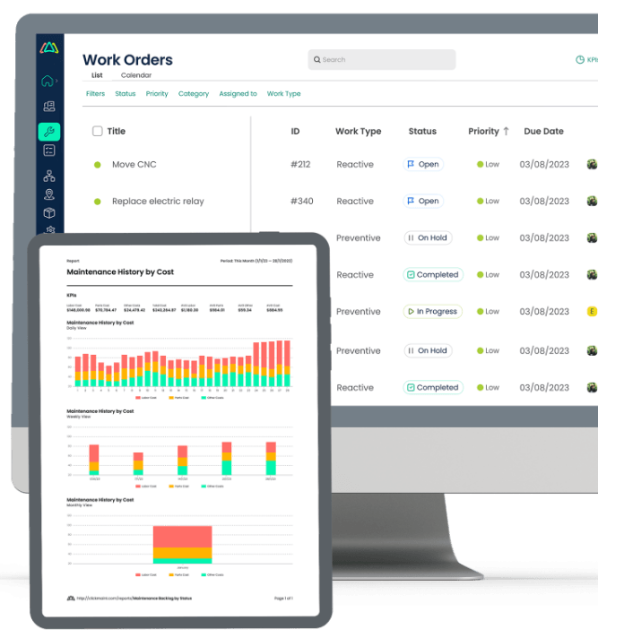
Digital tools such as work order management software are helping businesses organize these activities more efficiently by giving teams a structured way to submit requests, assign work, track progress, and maintain records. This type of system can also make it easier for managers to see which tasks are overdue, where resources are being used, and whether recurring operational issues need further attention.
Automation Is Moving Beyond Repetitive Office Tasks
Business automation used to be associated mainly with manufacturing or basic administrative functions. Today, its role is much broader.
Modern automation tools can trigger notifications, route requests to the correct employee, update records automatically, generate reports, and flag unusual activity. Instead of relying on someone to remember every step in a workflow, businesses can create predefined rules that keep routine processes moving.
This can be particularly useful when companies scale.
A small business may have no difficulty managing approvals manually when only a few requests arrive each week. Once that number increases into the hundreds, however, the same process can become a bottleneck.
Automation helps organizations expand their capacity without increasing administrative overhead at the same rate.
Artificial Intelligence Is Becoming More Practical
Artificial intelligence remains one of the most discussed areas of technology, but its real value for businesses may come from relatively practical applications.
AI is already being used to categorize customer inquiries, summarize large amounts of information, identify unusual patterns, predict demand, and assist employees with decision-making.
In operational environments, predictive capabilities may become particularly valuable.
For example, historical equipment data could help businesses identify when certain assets are more likely to fail. Instead of waiting for a breakdown, teams could schedule maintenance earlier and potentially avoid more expensive repairs or downtime.
Similar systems can analyze inventory trends, employee workloads, energy consumption, or customer activity.
As these tools become easier to use, businesses will not necessarily need dedicated data science teams to benefit from them. Many AI capabilities are likely to be incorporated directly into the software employees already use.
Connected Devices Are Creating More Useful Data
The Internet of Things has been discussed for years, but connected devices continue to become more practical and affordable.
Sensors can now monitor everything from temperature and energy use to equipment vibration, room occupancy, and environmental conditions.
That information can then feed directly into operational systems.
A facility manager, for example, might receive an alert if a piece of equipment begins operating outside its normal range. A warehouse could monitor environmental conditions automatically rather than relying solely on scheduled manual checks.
The real benefit is not simply collecting more data.
Businesses already generate enormous quantities of information. The challenge is turning that information into something employees can act on.
The most useful connected systems therefore combine monitoring with automated workflows. Data becomes valuable when it causes the right person to receive the right information at the right time.
Cybersecurity Will Become Part of Everyday Operations
As businesses become more connected, cybersecurity will become an increasingly important operational issue.
More cloud applications, connected devices, and mobile systems create more potential points of access.
Organizations therefore need to think beyond traditional antivirus software.
Employee access controls, multi-factor authentication, regular software updates, secure data backups, and clear procedures for handling sensitive information are becoming basic components of modern operations.
Technology providers are also incorporating more security controls directly into their platforms.
For businesses, the challenge will be balancing accessibility with protection. Employees need information to do their jobs efficiently, but access should still be limited according to genuine operational requirements.
Technology Works Best When Processes Come First
One of the biggest mistakes businesses can make is assuming that software alone will solve operational problems.
Technology is most effective when it supports a well-designed process.
If responsibilities are unclear or workflows contain unnecessary steps, digitizing them may simply preserve the same inefficiencies in a different format.
Organizations should therefore examine how work currently happens before introducing new systems.
Which steps are genuinely necessary?
Where do delays occur?
What information do employees need?
Which activities are being repeated unnecessarily?
Answering those questions makes it easier to select technology that solves a specific problem rather than simply adding another subscription.
The Next Decade Will Be About Integration
The biggest shift in business technology may not come from one revolutionary invention.
Instead, it is likely to come from increasingly connected systems.
AI, mobile applications, connected devices, automation, cloud platforms, and analytics are gradually becoming parts of the same operational ecosystem.
A sensor can detect an issue, software can automatically create a task, a technician can receive the request on a mobile device, and management can see the outcome on a dashboard without anyone manually transferring information between systems.
That level of integration can reduce delays, improve accuracy, and give businesses a much clearer understanding of how their operations are performing.
The organizations that benefit most will not necessarily be the ones adopting every new technology first. They will be the ones that identify genuine operational problems and use technology strategically to solve them.
As digital tools become more capable and more accessible, the competitive advantage will increasingly come from how effectively businesses connect technology with people and processes.
 Drevian Quenvale writes the kind of ai algorithms and machine learning content that people actually send to each other. Not because it's flashy or controversial, but because it's the sort of thing where you read it and immediately think of three people who need to see it. Drevian has a talent for identifying the questions that a lot of people have but haven't quite figured out how to articulate yet — and then answering them properly.
They covers a lot of ground: AI Algorithms and Machine Learning, Tech Innovation Alerts, Expert Tutorials, and plenty of adjacent territory that doesn't always get treated with the same seriousness. The consistency across all of it is a certain kind of respect for the reader. Drevian doesn't assume people are stupid, and they doesn't assume they know everything either. They writes for someone who is genuinely trying to figure something out — because that's usually who's actually reading. That assumption shapes everything from how they structures an explanation to how much background they includes before getting to the point.
Beyond the practical stuff, there's something in Drevian's writing that reflects a real investment in the subject — not performed enthusiasm, but the kind of sustained interest that produces insight over time. They has been paying attention to ai algorithms and machine learning long enough that they notices things a more casual observer would miss. That depth shows up in the work in ways that are hard to fake.
Drevian Quenvale writes the kind of ai algorithms and machine learning content that people actually send to each other. Not because it's flashy or controversial, but because it's the sort of thing where you read it and immediately think of three people who need to see it. Drevian has a talent for identifying the questions that a lot of people have but haven't quite figured out how to articulate yet — and then answering them properly.
They covers a lot of ground: AI Algorithms and Machine Learning, Tech Innovation Alerts, Expert Tutorials, and plenty of adjacent territory that doesn't always get treated with the same seriousness. The consistency across all of it is a certain kind of respect for the reader. Drevian doesn't assume people are stupid, and they doesn't assume they know everything either. They writes for someone who is genuinely trying to figure something out — because that's usually who's actually reading. That assumption shapes everything from how they structures an explanation to how much background they includes before getting to the point.
Beyond the practical stuff, there's something in Drevian's writing that reflects a real investment in the subject — not performed enthusiasm, but the kind of sustained interest that produces insight over time. They has been paying attention to ai algorithms and machine learning long enough that they notices things a more casual observer would miss. That depth shows up in the work in ways that are hard to fake.